INITWIN · Editorial
Software & digital strategy
Custom software vs. off-the-shelf solutions: how to choose what is right for your business
Honest comparison between generic ERP/CRM and custom applications: costs, flexibility, implementation time
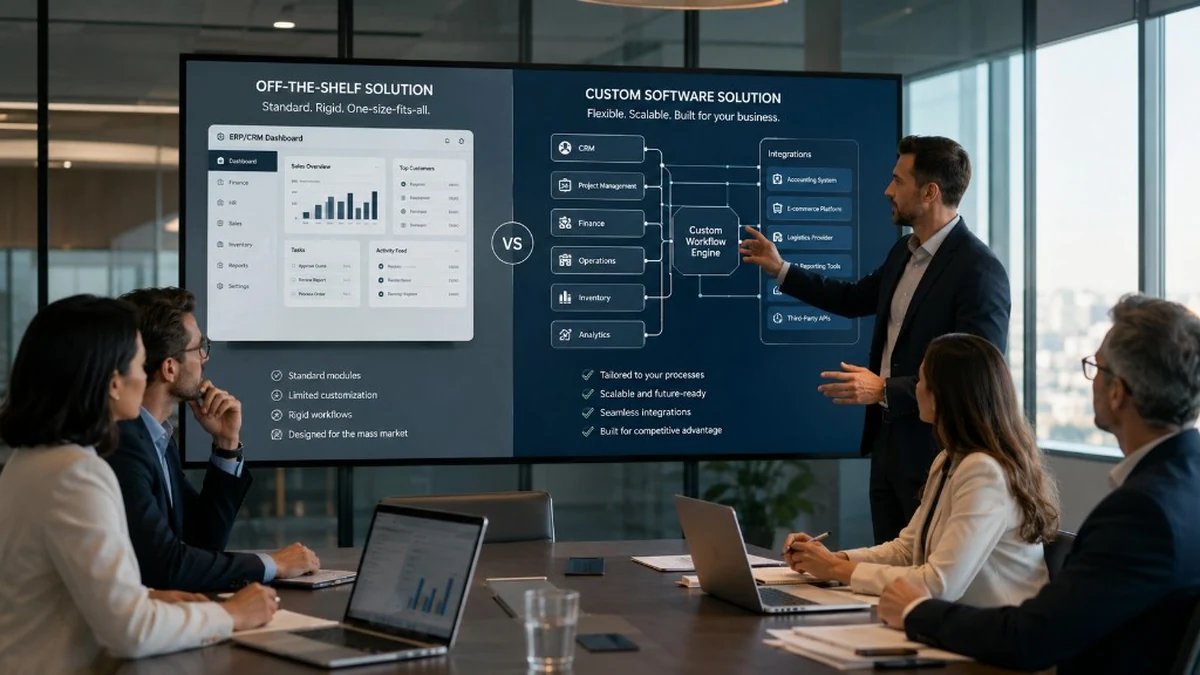
Choosing a software solution isn't just a technical decision—it's a business decision that impacts your organization's speed, costs, and ability to grow.
Choosing a business software solution influences how teams work, how quickly the company responds to customer demands, how well costs are controlled, and how easily the organization can grow in the coming years.
For many decision-makers, the question inevitably arises: do we choose an off-the-shelf solution, i.e. an already existing ERP, CRM or generic system, or do we invest in a custom software application, built specifically for our processes?
The correct answer is not the same for all companies. Sometimes a generic solution is the right choice. Other times, custom software can become a major competitive advantage. This article gives you an honest, practical and decision-oriented comparison.
What does off-the-shelf solution mean?
An off-the-shelf solution is a ready-made software product available to many companies. It can be a CRM, an ERP, a project management platform, an invoicing system, an accounting application or a SaaS solution for sales, HR, ticketing or ecommerce.
The main advantage is that the product already exists. You can buy the license, set up accounts, import data and start using relatively quickly. For companies with standard processes, without many peculiarities, this variant can be effective.
However, these solutions are built for a broad audience. They must cover the needs of many industries and many types of companies. For this reason, they come with general functionality, predefined settings and clear limits of customization.
What is custom software?
Bespoke software is an application built specifically for a company, starting from its actual processes, goals and needs. It can be a custom CRM, a modular ERP, a customer portal, a reporting platform or a tool integrated with other existing systems.
In the case of a generic solution, the company adapts to the software. In the case of a custom application, the software adapts to the company.
Costs: what seems cheap at first can become expensive
At first glance, off-the-shelf solutions seem cheaper: monthly subscription, cost per user, quick setup. But the real cost must be analyzed in the medium and long term.
A generic solution may include per-user licenses, additional modules, extra storage, fees for integrations, consulting, training and premium support. A 10-user CRM may seem affordable—but at 50, 100, or 300 users, plus modules and APIs, the cost becomes significant.
Bespoke software requires a larger upfront investment, but can be built in stages, starting with immediate impact functionality. Over time, it becomes a digital asset of the company, not just a monthly rent to an outside vendor.
Flexibility and implementation time
A generic ERP or CRM offers standard configuration — sufficient for many firms. The problem arises when your processes include special sales milestones, discount rules, tiered approvals, or reports in a format required by management. The team then creates parallel solutions: Excel, emails, shared files.
Off-the-shelf solutions win on initial speed of implementation. Custom software requires analysis and development — but the time invested builds the right solution. The MVP (essential mode first, incremental expansion) approach keeps the investment under control.
Generic ERP/CRM: When is it the right choice?
It is suitable when the processes are clear, simple and close to the market standard; the initial budget is limited; time is critical; or you don't want to manage infrastructure and updates — the provider takes care of hosting and security.
In other words, the generic solution is good if your need is generic.
Custom software: when is it worth the investment?
It is worth it when processes are specific, data is fragmented, reports are made in Excel, approvals are lost by email or managers do not have real-time data. It is also suitable when the way you deliver services or manage customers is part of your competitive advantage.
Integration, scalability and security
Modern companies use accounting, CRM, ecommerce, payments, courier, marketing, BI and HR. Generic solutions offer standard, often limited integrations. Custom software can connect APIs and create seamless workflows — an order from the portal can automatically generate a quote, stock update, notification and invoice.
Generic scalability comes with enterprise costs; the custom can be modular. On the security front, custom apps enable 2FA, auditing, departmental roles, and control over data location — essential in regulated domains.
User experience
Adoption matters more than the feature list. Custom software can show each role exactly what they need: operator, manager, customer, administrator — clear interface, logical steps, fewer errors.
Comparative table: off-the-shelf vs. custom software
| Criterion | Off-the-shelf solution | Custom software |
|---|---|---|
| Initial cost | Smaller | Bigger |
| Long term cost | It can grow through licenses and modules | Better control, phased investment |
| Implementation time | Fast in the beginning | Slower, but more adapted |
| Flexibility | Limited by platform | high |
| Personalization | Standard configuration | Purpose-built features |
| Integration | Existing integrations, sometimes limited | Integrations adapted exactly to needs |
| Scalability | Good, but with additional costs | Modular, controllable |
| Control over data | Limited by supplier | Bigger |
| Competitive differentiation | low | high |
| Matching processes | Partial | Very good |
How do you choose the right option?
Ask yourself: How standard are the processes? How much do you rely on integration? How important is data control? How quickly do you need to implement? How much do you want to differentiate yourself?
A balanced approach
Many companies combine the two: existing accounting + custom portal for customers; Generic CRM + customized reporting module; Current ERP + internal application that automates flows. You don't rebuild what works — you customize where you have real advantage.
Conclusion
There is no absolute winner. Generic solutions are fast and suitable for standard processes. Bespoke software provides flexibility, control, integration and deep customization.
The best decision starts with a clear analysis: what problems do you want to solve, where are money being lost, what systems are not communicating and what are your goals for the coming years. For some businesses, a generic CRM or ERP is sufficient. For others, a custom app—or a clever combination of the two—is the way to go.
Keep reading
- On-premise vs cloud vs hybrid: where to host your application and what each option costs in Romania
- Software for dental practices: online booking, digital patient records and automatic reminders
- Restaurant digitalisation: online ordering, kitchen stock management and daily sales reports
- Software solutions for real estate agencies: portfolio management, client CRM and automatic listing generation
Need guidance on a similar project or a technical audit?