INITWIN · Editorial
Software & digital strategy
On-premise vs cloud vs hybrid: where to host your application and what each option costs in Romania
Comparison for IT managers: AWS, Azure, own servers, colocation and clear selection criteria
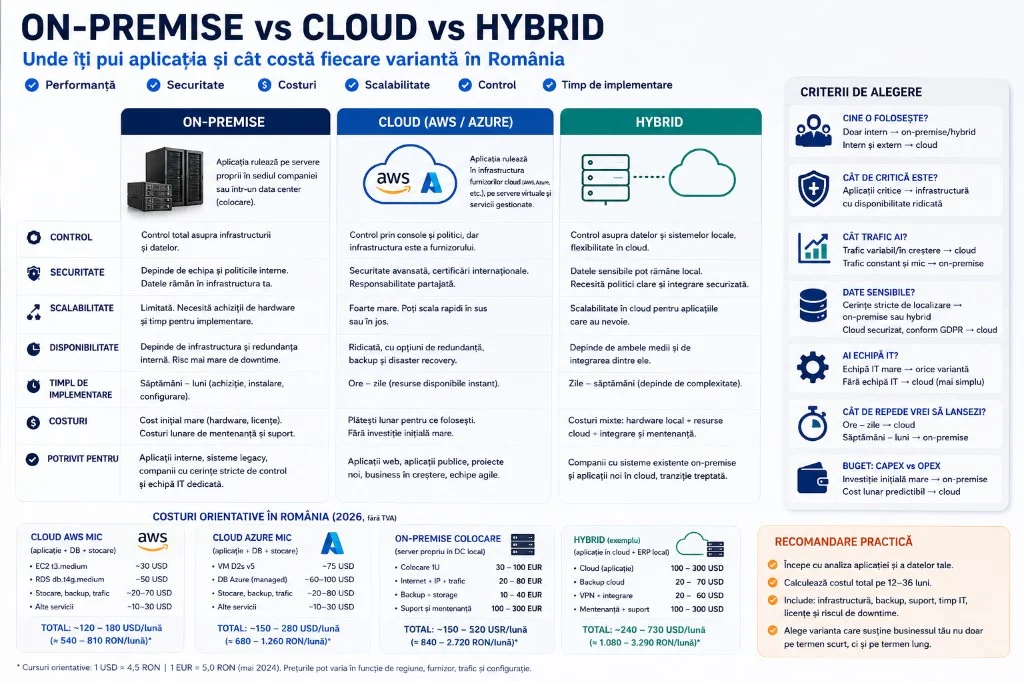
A practical comparison for IT managers: AWS, Azure, own servers, colocation and clear selection criteria.
One of the most important decisions in a software project is where the application will run. For the end user, this detail seems invisible. For the company, however, infrastructure choice affects costs, security, performance, scalability, maintenance and operational risk.
Many managers postpone this decision. Some say: “We’ll put the app on our server.” Others: “We’ll move it to the cloud.” Others want a mixed approach without knowing exactly what it involves.
Cloud is not automatically the best solution. Your own server is not automatically cheaper. Hybrid does not just mean “we’ll also put something in the cloud”. The decision depends on the application, data, traffic, budget, technical team and growth plans.
What does on-premise mean?
On-premise means the application runs on infrastructure controlled directly by the company: a physical server on site or your own server colocated in a data centre in Romania.
The variants are very different. A server in the office depends on power, internet, UPS, temperature and backup. Colocation offers redundant power, better internet, cooling and physical security, but involves a monthly rack hosting cost.
On-premise advantages and disadvantages
Advantages: full control; potentially predictable monthly costs after initial investment; suited to internal applications; integration with legacy systems (ERP, production); low latency for local equipment.
Disadvantages: full responsibility (hardware, patches, backup, security); large upfront investment; slow scaling; limited availability with a single server; backup often untested.
Indicative on-premise costs in Romania (2026)
Entry-level business server: ~10,000–20,000 RON. Serious configuration (32–64 GB RAM, enterprise SSD, RAID): 20,000–40,000+ RON. Plus UPS, firewall, backup, licences, installation, maintenance.
1U colocation in a Romanian data centre: approximately €30–100/month for small packages, depending on power, traffic, IP, support and SLA.
Operational estimate for a small app (colocated server): amortised hardware 400–1,200 RON/month; colocation 150–600 RON; backup 100–500 RON; IT maintenance 500–2,000 RON — total ~1,000–4,000 RON/month, excluding initial hardware cost.
What does cloud mean?
Cloud means the application runs on a provider’s infrastructure (AWS, Azure, Google Cloud, Hetzner, OVH, etc.). You do not buy a physical server — you rent compute, storage, databases, networking, backup, load balancing.
For Romania, regions are usually in the EU (Frankfurt, Paris, West Europe, Poland Central). Latency is acceptable for most web applications; for strict localisation in Romania, colocation or hybrid can be evaluated.
Cloud advantages and disadvantages
Advantages: fast start; scaling; managed services (RDS, S3, LB); high availability with correct architecture; lower initial cost; suited to public applications and SaaS.
Disadvantages: variable monthly bill; requires configuration expertise; vendor lock-in; egress cost at high traffic; dependency on office internet for internal users.
Indicative AWS costs
Minimum architecture for a small web app: EC2, EBS, RDS PostgreSQL, S3, backup, monitoring.
- EC2 t3.medium: ~$30–35/month;
- RDS db.t4g.medium: ~$47–55/month;
- storage, S3, snapshots, traffic: ~$30–150/month.
Indicative total: $120–250/month (~€110–230), excluding heavy traffic. Medium app (LB, staging+prod, stronger RDS): $400–1,500+/month.
Indicative Azure costs
Suited to companies with a Microsoft ecosystem (M365, Entra ID, SQL Server). VM D2s v5 + disk + managed DB + backup.
Small app: $150–350/month (~€140–320). Medium: $500–2,000/month. Integration with Microsoft identity can offset some costs through operational efficiency.
Cloud is not just a VM
A common mistake: copying a physical server 1:1 to the cloud. Modern models: containers, serverless, managed DB, object storage, CDN, cache, Kubernetes. Lift-and-shift without analysis can become expensive — redesigning for cloud reduces costs.
What does hybrid mean?
Part of the infrastructure stays local, part in the cloud. Common examples in Romania:
- local ERP + client portal in the cloud;
- main DB on-premise + BI in the cloud;
- cloud web app + VPN to internal systems;
- local backup sent to the cloud;
- cloud online store + stock from local ERP.
Hybrid advantages, disadvantages and costs
Advantages: gradual transition; legacy integration; sensitive data kept locally; disaster recovery in the cloud.
Disadvantages: complexity (VPN, firewall, monitoring); connection dependency; security across two environments; harder debugging.
Indicative cost for small/medium setup: cloud 500–2,000 RON; VPN/backup/monitoring 200–1,000 RON; maintenance 1,000–4,000 RON — total ~1,500–6,000 RON/month, excluding integration cost (often the largest).
Quick comparison
- On-premise — local control, internal apps, legacy, existing IT team.
- Cloud — fast launch, scaling, public access, managed services.
- Hybrid — important local systems + modern external apps, without immediate full migration.
Clear selection criteria
- How critical is the application? (availability, recovery)
- Who uses it? (internal only vs. external clients)
- How much traffic? (steady vs. variable/growing)
- Do you have an internal IT team?
- Sensitive data? (medical, financial, legal)
- Rapid scaling needed?
- Legacy systems to integrate?
- CAPEX vs. OPEX budget?
- How much downtime can you accept?
- How fast do you want to launch?
Common mistakes
- on-premise “cheaper” without counting maintenance, backup and downtime;
- cloud without cost monitoring;
- untested backup (anywhere);
- single server for a critical application;
- no staging environment;
- ignoring egress and traffic;
- infrastructure chosen before understanding the application.
Practical recommendation
SME — new application: cloud is often the best initial choice (launch, low cost, scaling). Simple internal: on-premise only with serious support and backup. With local ERP: realistic hybrid.
Enterprise: decision tied to compliance, cost control, 3–5 year continuity. Hybrid frequent for transition — existing critical systems + new apps in the cloud.
Conclusion
On-premise offers control, but requires investment and responsibility. Cloud offers flexibility and scaling, but requires cost discipline. Hybrid offers transition, but adds complexity.
For Romania, calculate total cost: hardware, colocation, maintenance, support, backup, downtime, integration. The choice starts from the application — who uses it, how critical it is, what data it handles, what systems it integrates.
Good infrastructure is not the cheapest on paper. It is what supports the business safely, with controlled costs and the ability to grow without bottlenecks.
Keep reading
- Why do my emails go to spam? Complete guide to SPF, DKIM, DMARC and server reputation
- How to build your own company email server with Mailcow, without monthly per-user subscriptions
- How to prepare your team for new software: training, adoption and resistance to change
- The 8-week MVP: how to launch a product idea without burning the budget
Need guidance on a similar project or a technical audit?