INITWIN · Editorial
Software & digital strategy
Software solutions for transport and logistics companies: tracking, dispatch and automatic reports
Integrated GPS tracking, fleet management, digital CMR documents and automatic invoicing
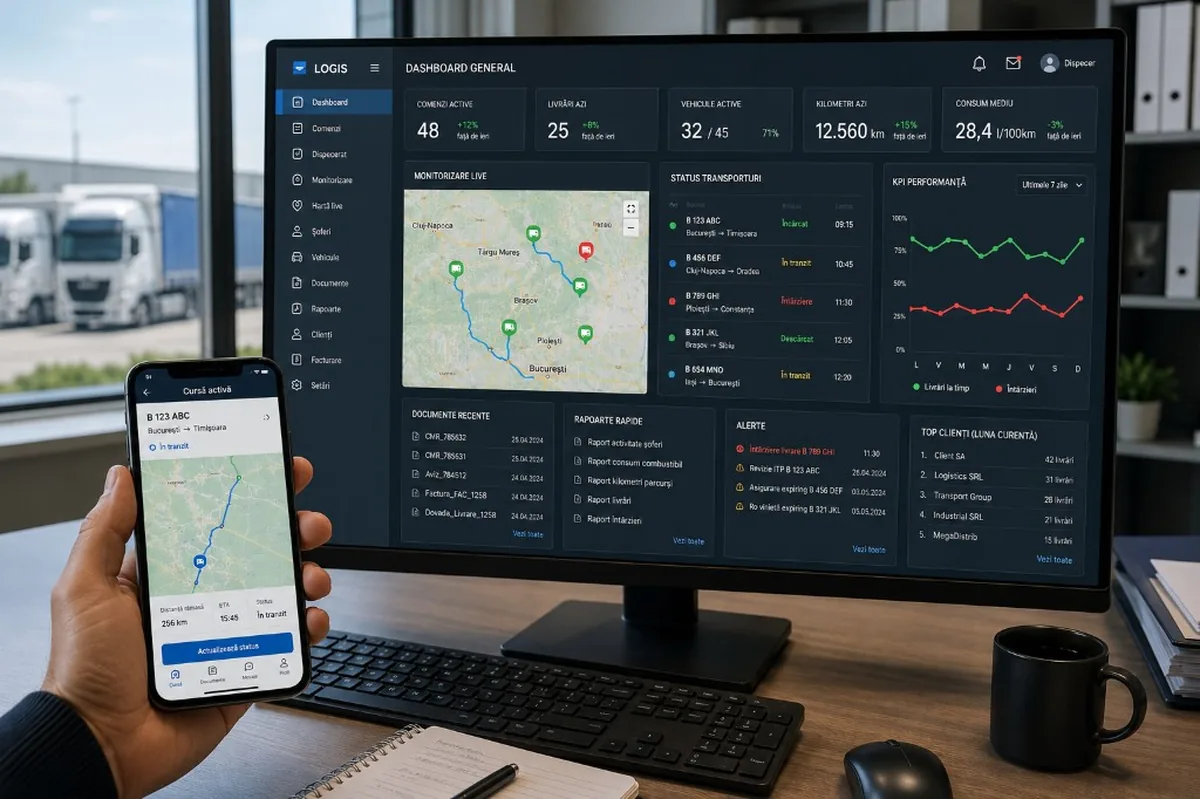
Integrated GPS tracking, fleet management, digital CMR documents and automatic invoicing — software solutions for transport and logistics companies.
Transport and logistics are fields where every minute counts. A delayed trip, a truck used inefficiently, poor communication between dispatch and driver, an incomplete CMR document or a late invoice can directly affect company profit.
In a transport company, activity moves constantly: trucks, drivers, clients, orders, routes, documents, fuel, maintenance, delivery confirmations and reports. If everything is managed by phone, WhatsApp, Excel and email, control becomes difficult.
Transport software is no longer reserved for large companies. Small and medium companies can also use tracking, dispatch, fleet management, digital documents and automatic reporting — phased implementation focused on real problems. A good system reduces unnecessary calls, centralises data and gives management a clear picture of trips, costs and performance.
Why transport companies need dedicated software
Without a centralised system you get: trips hard to track, lack of truck visibility, repetitive communication with drivers, late documents, delayed invoicing, manual reports, costs hard to attribute per trip, unanalysed idle time, clients constantly asking for statuses, duplicate data across different systems.
Dedicated software connects: order → planning → dispatch → execution → tracking → documents → delivery confirmation → invoicing → reporting.
Integrated GPS tracking: not just "where is the truck"
GPS separate from operations = the dispatcher sees the map on one platform, the order in Excel, documents by email. Integrated tracking links position to trip, client, route, delivery deadline and operational status.
- vehicle location, active trip, on schedule or delayed;
- idle time, route travelled, arrival/departure at loading-unloading;
- distance, deviations from planned route;
- client notifications or tracking link.
Pitfall: GPS as an isolated tool. Value appears when it is linked to orders, documents, dispatch and reports.
Digital dispatch: the operational centre
Orders, vehicle allocation, driver communication, statuses — often by phone, messages, Excel. Digital dispatch: active orders, vehicle/driver allocation, trip calendar, statuses, map, delay alerts, documents per trip, communication, event history, loading/unloading confirmations.
All information in one place: client, address, cargo, deadline, driver, truck, documents, status. Traceability for management: who allocated, when status changed, what problems appeared.
Driver application
The driver sees the trip, confirms departure/loading/unloading, uploads document photos, reports incidents, attaches proof of delivery, receives instructions, updates status.
Rule: simple, fast — weak signal, limited time, operational pressure. Too many steps = system unused.
Fleet management
Trucks, trailers, costs, maintenance, utilisation. Tracking: active vehicles, km, consumption, services, MOT, insurance, road tax, repairs, tyres, documents, drivers, cost/km, profitability per vehicle.
Pitfall: data without useful reports — cost per vehicle/trip, average consumption, loaded vs. empty km, availability.
Digital CMR documents and eCMR
CMR, proof of delivery, notices, invoices — on paper = slow, error-prone. Digital: CMR generation, photos/scans, electronic signature/confirmation, archiving per trip, transmission to client, link with invoice.
eCMR = electronic document managed, signed, transmitted, verified — not just a PDF. Pitfall: CMR photo on WhatsApp ≠ real, structured, secure eCMR flow.
Automatic invoicing
Ideal flow: order → allocation → loading confirmation → tracking → delivery confirmation → documents → trip completed → invoice generated/prepared → client receives invoice.
Accelerates cash flow. Pitfall: automation without checks — rates, km, taxes, waiting time, additional costs, contractual conditions, mandatory documents.
Automatic reports for management
- completed/delayed trips, revenue per client/vehicle/trip;
- km travelled, empty km, fuel/service cost;
- idle time, driver performance, fleet utilisation;
- invoices issued/unpaid, missing documents, incidents.
Client portal
Active orders, transport status, documents, proof of delivery, invoices, history, notifications — reduces repetitive calls. Transparency as a B2B differentiator.
Integration with ERP, accounting and external platforms
ERP, accounting, existing GPS, fuel, freight exchanges, SMS, eCMR, client APIs. Example: order via API → dispatch → GPS → driver documents → invoice → status back to client.
Pitfall: superficial integration — duplicates, errors, confusion. Design, testing, monitoring.
What do you automate first?
| Main problem | First step |
|---|---|
| Lack of trip visibility | Digital dispatch + integrated tracking |
| Slow documents and invoicing | Digital CMR + invoicing flow |
| Fleet costs hard to track | Fleet management + cost reports |
| Clients constantly ask for status | Client portal + automatic notifications |
| Growth + partners | APIs + data structure |
Standard software or custom application?
Standard — simple processes, fast implementation. Custom — specific flows, clients with special requirements, integrations, reports, unified ecosystem. Hybrid — existing GPS + internal software for dispatch, documents, invoicing.
Common pitfalls
- software without process analysis;
- ignoring drivers and dispatchers;
- separate systems (GPS, Excel, email, invoicing);
- data without useful reports;
- lack of security (roles, permissions, audit).
What a realistic implementation looks like
Analysis with dispatchers, drivers, management, accounting → v1: orders, allocation, statuses, GPS, documents, reporting, invoicing export → extension: mobile app, portal, fleet, integrations. Training essential for dispatchers, drivers, management.
Conclusion
Digitalisation can have rapid impact: integrated GPS, digital dispatch, driver app, CMR/eCMR, fleet management, automatic invoicing, reports. Do not automate everything on day one — start where the most time or money is lost.
In a field with tight margins and strong competition, digitalised companies work faster, more transparently and more profitably. Software becomes the operational infrastructure that connects people, vehicles, documents, clients and money.
Keep reading
- Why do my emails go to spam? Complete guide to SPF, DKIM, DMARC and server reputation
- How to build your own company email server with Mailcow, without monthly per-user subscriptions
- How to prepare your team for new software: training, adoption and resistance to change
- Qualified electronic signature in business applications: how to integrate it and what legal effect it has
Need guidance on a similar project or a technical audit?