INITWIN · Editorial
Software & digital strategy
Agile vs Waterfall: which working methodology we use and why it matters for you as a client
How we work at INITWIN: incremental deliveries, constant feedback and no surprises at the end
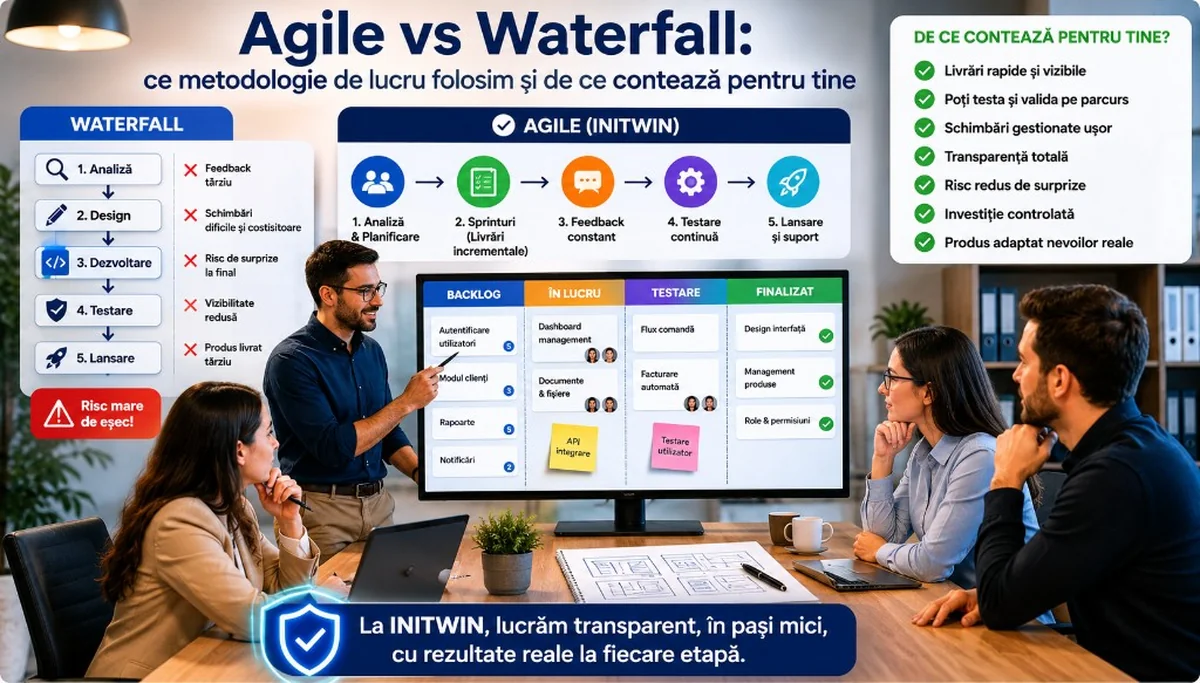
How we work at INITWIN: incremental deliveries, constant feedback and no surprises at the end — Agile, Waterfall and the hybrid approach explained for non-technical clients.
When a company decides to build a software application, the conversation usually starts with features, budget and delivery deadline. The client wants to know how much it costs, how long it takes and what they get at the end. All of these questions are normal.
But there is an equally important question that many clients do not ask from the start: How will the project be managed?
The working methodology can make the difference between a clear, controlled and predictable project and one that ends up delayed, more expensive and delivering something other than what the client imagined.
In software development, two concepts appear frequently: Waterfall and Agile. For a non-technical client, these terms can sound like management theory. In reality, they directly influence how you will collaborate with the development team, how quickly you will see progress, how easily you can give feedback and how high the risk is of discovering problems only at the end.
At INITWIN, we use a pragmatic approach: we combine the clarity of an initial analysis stage with the flexibility of incremental deliveries. We do not start without direction, but neither do we build for months in isolation, only to show the client the final product and hope it is exactly what they wanted.
What is the Waterfall methodology?
Waterfall is a classic software development methodology. The name comes from the idea of a “cascade”: the project flows in a single direction, stage after stage.
In a Waterfall process, things usually happen like this:
- analysis is done;
- specifications are written;
- design is completed;
- the application is developed;
- it is tested;
- it is launched.
Each stage starts after the previous one is finished. In theory, the process is very orderly. In practice, it works well when the project is very clear from the beginning, requirements are stable and changes are rare.
For example, Waterfall can be suitable for projects with fixed specifications, very clear rules and a low risk of change along the way. In certain industries or regulated projects, this approach can make sense.
The problem appears when the client discovers along the way that they need something different from what they initially thought. Or when real users test the application and notice that the flow needs adjusting. Or when the market, internal processes or priorities change during the project.
In Waterfall, late changes can be costly, because many decisions have already been turned into code, design and technical structure.
The advantages of Waterfall
Waterfall has a few clear advantages.
The first advantage is initial predictability. If requirements are very well defined, a detailed plan can be created with stages, deliverables and deadlines.
The second advantage is documentation. Waterfall projects usually put emphasis on detailed specifications before development.
The third advantage is discipline. For projects where changes must be strictly controlled, this methodology can provide stability.
For clients, Waterfall can feel comfortable at the start: there is a large, complete plan with everything that will be built. But initial comfort does not guarantee a good result if the project is complex and requirements are not fully clear from day one.
The pitfalls of Waterfall
The biggest pitfall is feedback received too late.
If the application is built for months without users seeing and testing intermediate modules, the risk is high that the final product will not match real expectations.
The client may say at the end: “Yes, it is what I asked for, but it is not exactly what we need.”
This is one of the most painful situations in a software project. The technical team delivered according to the specifications, the client paid, but the application does not fit the real process perfectly.
Another pitfall is rigidity. In business, things change. New ideas appear, priorities shift, exceptions are discovered, new users get involved. If the methodology does not allow adaptation, the project becomes tense.
Waterfall is not wrong in itself. But for many modern web applications, portals, custom CRMs, internal platforms or digital products, a fully rigid approach can be risky.
What is the Agile methodology?
Agile is a working methodology based on incremental deliveries, collaboration and adaptation. Instead of the team building the entire product behind the scenes and presenting it only at the end, the application is split into smaller stages.
The client sees progress periodically, tests modules, gives feedback and can adjust priorities. In an Agile process, the project is not treated as one huge block, but as a controlled evolution.
For example, for a client portal, the first stage may include authentication, user accounts and the basic structure. The second stage may include documents. The third stage may include notifications. The fourth stage may include reports. The fifth stage may include billing integration.
After each stage, the client can see something concrete. This approach reduces the risk of surprises at the end. If something is not right, it is discovered earlier, when it is easier and cheaper to fix.
The advantages of Agile for the client
For the client, Agile has one major advantage: visibility. You do not wait months to see the application. You receive intermediate versions, demos, working modules and the chance to give feedback.
- Flexibility — if you discover that one feature is more important than another, priorities can be adjusted.
- Risk reduction — problems appear earlier, not at the end.
- Involvement of real users — the team that will use the application can test the modules.
- Investment control — you can start with an essential version and extend it gradually.
The pitfalls of Agile
Agile does not mean chaos. That is a common misunderstanding.
Some people believe Agile means “we no longer plan” or “we change anything, anytime”. Wrong.
A healthy Agile project has clear objectives, priorities, meetings, deliverables, testing and responsibilities. The difference is that the plan is not treated as a fixed stone, but as a tool that can be adjusted intelligently.
The pitfall appears when Agile is used as an excuse for lack of structure. If there is no project owner, if feedback is delayed, if requirements change daily without prioritisation, then the project can become hard to control.
That is why at INITWIN we do not use Agile as a slogan. We use it as a method of controlled collaboration.
How we work at INITWIN
At INITWIN, our approach is simple: clarity at the start, incremental delivery along the way, constant feedback and support after launch.
We do not believe in projects that start directly with coding, without analysis. But neither in projects where the client sees the result only at the end.
That is why our process combines the most useful elements from both worlds.
- From Waterfall we keep the initial clarity: discovery, defining objectives, understanding processes, prioritising features and estimating stages.
- From Agile we keep the delivery mode: incremental, visible, with feedback and controlled adjustments.
This approach is suitable for custom software applications, client portals, internal platforms, web apps, personalised CRMs, dashboards, reporting systems and solutions integrated with other applications.
Stage 1: Discovery and understanding the business
The first step is to understand the real problem. We do not start from the question “what buttons should the application have?”, but from more important questions:
- What business problem needs to be solved?
- Who will use the application?
- What processes exist now?
- Where is time being lost?
- What is done manually?
- What systems need to be integrated?
- What data is important?
- What reports are needed?
- What is mandatory for the first version?
- What can be added later?
This stage reduces the risk of building an application that looks good but does not truly help the company. For the client, discovery is the moment when the idea becomes a project. You do not need to have all the technical answers. You need to explain as clearly as possible how the business works and what result you want to achieve.
Stage 2: Prioritisation and roadmap
After discovery, we split the project into features and stages. Not all ideas need to be built in the first version. Some are essential, others are useful, and others can be left for later.
This prioritisation is very important for budget, timeline and quality.
For example, in a client portal, the first version may include authentication, client profile, documents and notifications. In a later stage, online payments, chat, electronic signature or advanced reports can be added.
A clear roadmap helps the client understand what they get first, what comes next and how the application can evolve.
Stage 3: Design and prototyping
Before we fully develop the features, it is important that the interface and main flows are validated.
Design does not mean only colours and visual appearance. It means how the user moves through the application, what they see first, how many steps they have to go through and how easily they can complete an action.
For many projects, prototyping helps enormously. The client can see the application structure before everything is programmed. It is much easier to change a prototype than a feature that is already fully developed.
Stage 4: Incremental development
Once the direction is clear, development is done in stages. We do not build everything in isolation. We deliver modules, present them, test them and collect feedback.
For example, in a software project, we can deliver incrementally:
- authentication and roles;
- user administration;
- client management;
- documents;
- notifications;
- reports;
- dashboard;
- integrations;
- exports;
- advanced features.
Each delivered module gives the client visibility into progress. We do not discuss only in theory, but on something concrete. This method also helps the technical team, because feedback comes earlier and can be integrated more efficiently.
Stage 5: Constant feedback
Feedback is essential. But it must be organised.
In healthy projects, the client does not give random feedback from many different directions, without prioritisation. Feedback must be centralised, discussed and turned into decisions.
That is why we recommend that every project has an owner on the client side. This person does not need to be technical, but must be able to validate features, centralise observations and make decisions.
Good feedback answers concrete questions:
- is the flow correct?
- is important information missing?
- is the interface clear?
- can users work quickly?
- does the report answer the business question?
- is the feature enough for the first version?
Constant feedback means fewer surprises at the end.
Stage 6: Testing with real scenarios
Testing is not only the responsibility of the technical team. The technical team checks whether the application works. The client checks whether the application works correctly for the business.
That is why we encourage testing on real scenarios.
- If the application manages orders, we test the full flow of an order.
- If the application manages documents, we test upload, access, download and permissions.
- If the application has roles, we test what each role sees.
- If the application generates reports, we verify that the values are correct.
Testing done well prevents problems after launch. It is better to discover an ambiguity in the test stage than after end users use the application daily.
Stage 7: Controlled launch
Launch should not be a risky moment. A good launch is prepared.
We check the server, domain, database, accounts, permissions, backups, emails, integrations and important flows.
In some projects, we recommend a gradual launch. First for a small team, then for all users. This approach reduces risk and allows fast adjustments.
For the client, a controlled launch means more safety. We do not throw the application into production without checks.
Stage 8: Support and improvements after launch
A software project does not end on launch day. After launch, feedback, new ideas, adjustments and optimisations appear. This is normal. A good application evolves together with the business.
That is why we discuss maintenance, support and future developments from the start. Support can include:
- fixes;
- updates;
- monitoring;
- backup;
- optimisations;
- new features;
- adjustments based on feedback;
- security;
- user assistance.
For the client, this stage is important for continuity. The application does not stay locked at the first version. It can grow with the company.
What “no surprises at the end” means
When we say we work without surprises at the end, it does not mean that changes or challenges never appear. In software, they can appear.
It means that:
- we do not let problems pile up until the last week;
- we show progress along the way;
- we discuss risks early;
- we validate modules before we go too far;
- feedback is part of the process, not a final reaction;
- the project is transparent.
For the client, that builds trust. You know what is being built, what stage the project is in and what decisions need to be made.
Why methodology matters for you as a client
Methodology is not an internal detail of the software company. It affects you directly.
- It influences how quickly you see progress.
- It influences how easily you can correct the direction.
- It influences how clear the budget is.
- It influences how many surprises appear at the end.
- It influences how well the application is adopted by users.
- It influences the quality of the final result.
A good process does not automatically guarantee success, but it greatly reduces risks. And in a software project, reducing risks is essential.
Agile or Waterfall: what do we choose?
Our answer is: we do not choose the methodology as a label. We choose the process that fits the project.
If the project has very clear and fixed requirements, we can work with more well-defined stages, closer to Waterfall. If the project involves discovery, a new product, flows that need validation or users who will give feedback, Agile-style incremental deliveries are much more suitable.
In most custom software projects, we use a hybrid approach:
- analysis and structure at the start;
- incremental development;
- constant feedback;
- module testing;
- controlled launch;
- support after launch.
This combination offers clarity without rigidity and flexibility without chaos.
The client’s role in the process
For the methodology to work, the client has an important role. A successful project needs:
- a project owner on the client side;
- feedback given on time;
- access to real users;
- clear decisions;
- prioritisation;
- active testing;
- open communication.
We do not ask the client to become a technical specialist. But we need them to take part in business decisions. The technical team can propose solutions, but the client knows best the company’s processes, people and objectives.
Good software is built in collaboration.
Conclusion
Agile and Waterfall are not just technical terms. They are different ways of managing risk, change and collaboration in a software project.
Waterfall offers structure and predictability when requirements are stable. Agile offers flexibility, constant feedback and incremental deliveries when the project needs to be validated along the way.
At INITWIN, we use a pragmatic approach: we start with clear analysis, define priorities, deliver incrementally, test constantly and adjust based on feedback. The goal is simple: the client should know what is happening, see progress and not discover major problems only at the end.
For you as a client, methodology matters because it gives you control, transparency and safety. You do not just receive an application at the end. You take part in building it, see how it evolves and can influence the direction before it is too late.
A successful software project is not only about code. It is about process, collaboration and trust. And a good process is the one that turns an idea into a useful product, step by step, without unnecessary surprises and with clear results for the business.
Keep reading
- Why do my emails go to spam? Complete guide to SPF, DKIM, DMARC and server reputation
- How to build your own company email server with Mailcow, without monthly per-user subscriptions
- How to prepare your team for new software: training, adoption and resistance to change
- The 8-week MVP: how to launch a product idea without burning the budget
Need guidance on a similar project or a technical audit?